By Gary Zhang, CEO of Vizard.ai
AI is moving from helping people complete individual tasks to taking responsibility for the finished work.
Coding is the clearest example. Not long ago, AI could suggest the next line of code or generate a small function. Today, coding agents can read a codebase, understand a request, plan an implementation, write and test the code, fix errors, and return a completed change. The engineer still decides what should be built, but more of the execution can now be handed off.
We believe video is one of the next industries where this shift will happen.
Today, we are launching Vizard Agent, an AI video editor that can take a brief, understand the materials available, make the creative and technical decisions in between, and deliver a finished video.
The idea is simple: instead of giving AI a series of editing commands, you give it the outcome you want.
Video has been automated one task at a time
Video already has a lot of AI.
There are models that generate video, tools that write scripts, products that remove pauses, create captions, translate speech, find highlights, clean audio, generate graphics, and turn text into video. Each of these has made one part of the process easier.
But the person making the video is still responsible for the whole job.
You still have to decide what needs to happen, choose the right tool, move work from one place to another, keep the story coherent, catch mistakes, make revisions, and eventually turn all of those individual outputs into something finished. The tasks have become easier, but the job itself has not gone away. That distinction is already present in the earlier draft, where the difference between a tool and a worker is framed as the difference between completing a specific instruction and understanding the objective, deciding what needs to happen, and carrying out the work.
That is the gap Vizard Agent is built for.
You should not have to brief an AI by saying, “Remove these pauses, add captions here, generate three pieces of b-roll, change the music, then resize this for another platform.”
You should be able to say, “Make a launch video for this product,” or “Turn this idea into a video ad,” or “I have all of this material and I need something worth publishing.”
The agent should figure out the steps in between.
One agent for the whole video job
Vizard Agent is not built around one type of video or a short list of use cases.
You can start from an idea, footage, an existing video, an image, a document, a script, a website, or other context. What the agent needs to do from there depends on the job.
It may need to understand the material, research the topic, develop an angle, write or restructure a script, create new visuals, edit existing footage, work with audio and voice, transform content, or combine several of those things into one project.
But those are implementation details.
The point of the product is that you should not have to manage those capabilities as separate features. You give the agent a job, it works on the job, and you review the result.
That is also why we think of this as a general video agent rather than another AI editing feature. The goal is not to build twenty separate tools under one interface. The goal is one system that can take on many different kinds of video work.
From a brief to a finished video
The easiest way to understand the difference is to look at how we used Vizard Agent for one of our own launch projects.
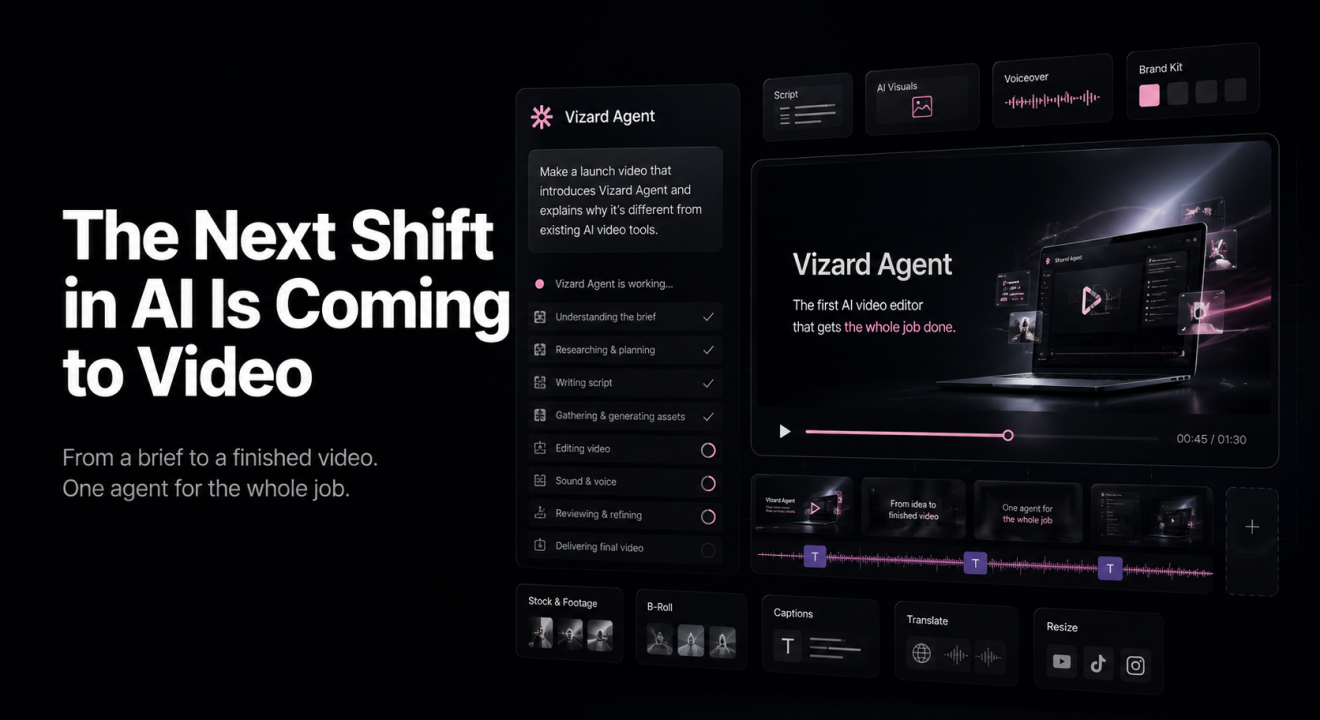
We gave it a simple brief: make a launch video that introduces Vizard Agent, explains why it is different from existing AI video tools, and makes the product feel ambitious without turning the video into a feature walkthrough.
We did not break that request into a list of editing instructions or tell the agent which individual tools to use. We described the outcome we wanted.
The agent worked through the project, decided how to structure the story, selected what needed to be shown, created the missing pieces, and assembled a first cut. The overall direction was right, but a few parts felt too slow and some of the messaging did not land as clearly as we wanted.
So we gave it feedback the same way we would give feedback to an editor. We asked it to tighten the opening, make the product difference clearer, and reduce the sections that felt too much like a traditional feature demo. It revised the video and came back with another version.
That interaction is the product experience we care about. You give the agent a goal. It does the work. You review the result, give direction, and it keeps going until the video is where you want it to be.
The individual operations still exist underneath. You just do not have to manage them one by one.
The work it can take on today
Vizard Agent is designed to take on video work broadly, rather than a fixed set of formats or use cases. You can start with raw footage, an existing video, a script, an article, a product page, images, a creative brief, or simply an idea. What happens next depends on what you are trying to make.
Sometimes that means turning hours of footage into a finished piece. Sometimes it means starting with almost nothing and building the video from the brief. The agent can work with existing material, generate what is missing, restructure content, create new scenes or visuals, adapt a video for a different audience or platform, and carry the project through multiple rounds of revision.
In practice, people are already using it for everything from ads and product launches to educational content, social videos, YouTube, repurposing, localization, and projects that mix real footage with generated material. Those are examples, not separate modes inside the product. The same agent decides what the job requires based on the brief.
That is an important difference from most AI video products today. You do not need to decide upfront whether you need a clipping tool, a generator, a translator, a scriptwriter, or an editor. A single project may require several of those capabilities, and the agent can move between them as part of the same job.
What matters most today is not the category of video, but how clearly the goal can be communicated. The better the agent understands what you want, the audience you are making it for, and what a good result should feel like, the more of the execution it can take on.
There are still projects where human direction matters more, especially when the work requires long chains of tightly coordinated decisions or very specific creative judgment. But we think of those as limits of the current generation of agents, not as boundaries around what Vizard Agent is meant to do.
The honest part
Vizard Agent can already take on surprisingly large video jobs, but that does not mean every job comes back perfect on the first try.
Agents today can still lose coherence over a long or complicated task. A decision made early in the process may not carry perfectly through everything that happens later. Visual style can drift. The tone of one section may not match another. Sometimes the agent makes a reasonable decision, just not the decision you would have made.
When that happens, a person still needs to step in and give direction.
In that sense, using an agent today can feel a little like working with a very fast teammate who can take on a large amount of execution, but who occasionally needs you to say, “That is not quite what I meant. Try it this way.”
We think it is important to be clear about that. The product is not a magic button, and one prompt will not always produce the final result.
At the same time, the limitations we see today are moving quickly. The underlying models are getting better at reasoning, context, memory, multimodal understanding, generation, and consistency. Improvements in any one of those areas make the agent better. Improvements across all of them compound.
Coding gives us a useful reference point. Two years ago, coding models often produced isolated snippets that were difficult to use. Today, coding agents can work across large repositories and complete meaningful engineering tasks.
We expect video to move along a similar curve. Some of the problems that feel obvious today may simply stop being important a year or two from now.
Why video is next
There is a reason we think video is especially ready for this shift.
Almost the entire production process is digital. The inputs are digital, the tools are digital, and the final output is digital. Much of the work in between involves understanding information, making decisions, operating tools, evaluating results, and iterating until something is finished.
That is exactly the kind of execution agents are beginning to absorb.
Video is also unusually fragmented. A final video may be thirty seconds long, but producing it can involve research, writing, footage, generation, editing, graphics, sound, localization, formatting, and revision. For years, software companies have made each of those steps faster. Agents create the possibility of something different: you no longer have to manage every step yourself.
That changes the economics of video work.
A marketer can spend less time coordinating production and more time deciding what message matters. A creator can spend less time learning software and more time developing ideas. A video team can spend less time on repetitive execution and more time on taste, judgment, and direction.
The human still decides what should exist and what good looks like. The agent takes on more of the work required to get there.
Try giving it a real job
Vizard started by helping people turn long videos into short clips. Over time, it became clear that clipping was only one part of a much larger problem. People do not need another isolated video feature. They need a way to get from an idea, a brief, or a pile of material to something finished without manually managing every step in between.
Vizard Agent is our first attempt at building that experience.
It is available today at https://agent.vizard.ai/.
If you try it, do not give it a test prompt. Give it something you actually need to make. Give it the launch your team has been delaying, the video sitting unfinished, the idea you have not had time to produce, or the project that would normally require too many tools and too much coordination.
Then tell us where it works, where it fails, and where you still have to step in.
This is the first version. We think the distance between an idea and a finished video is about to get much shorter.