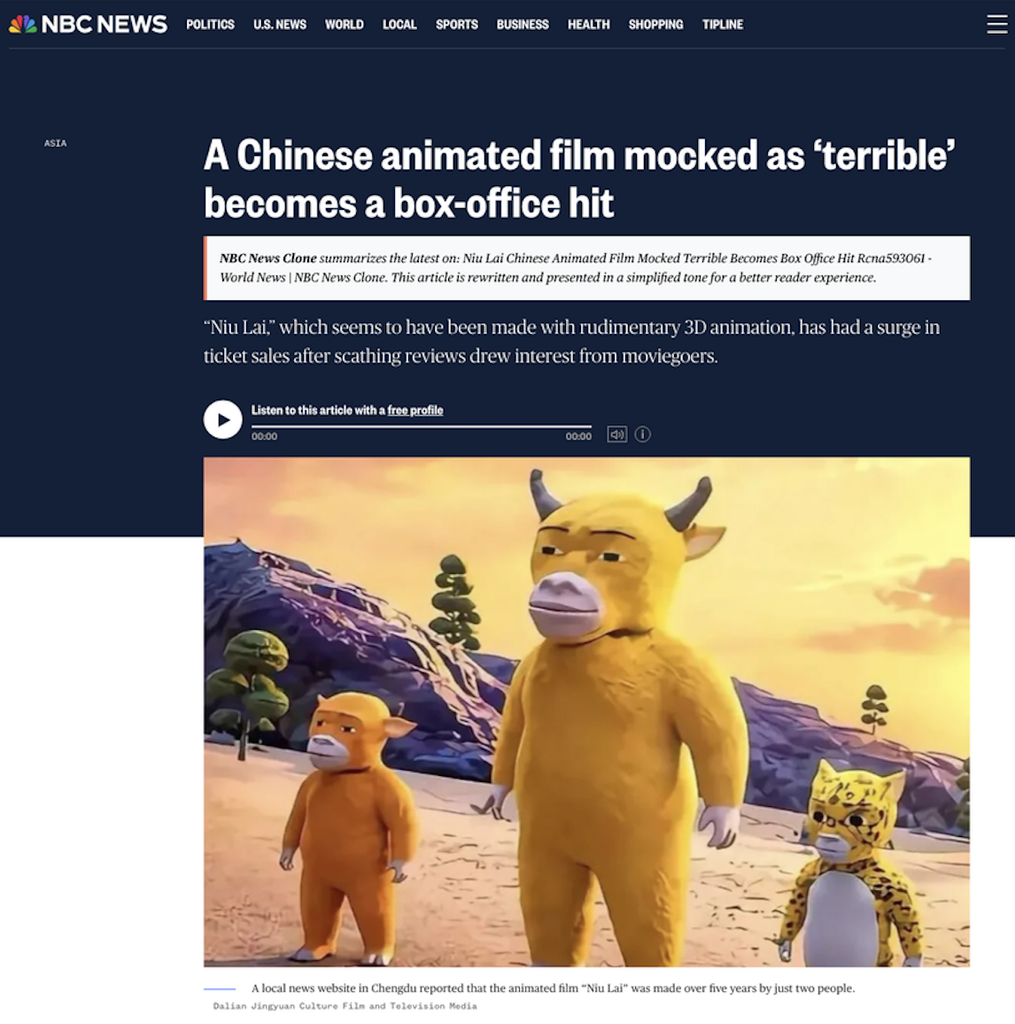
Niu Lai is probably the strangest movie of this summer. It made about 7,000 yuan ($1,040) in its first nine days in theaters. Then the internet turned it into a running joke, the box office climbed past 40 million yuan (roughly $5.95 million), and Niu Lai-related topics piled up more than 2.7 billion views. Even USA Today and NBC covered it.
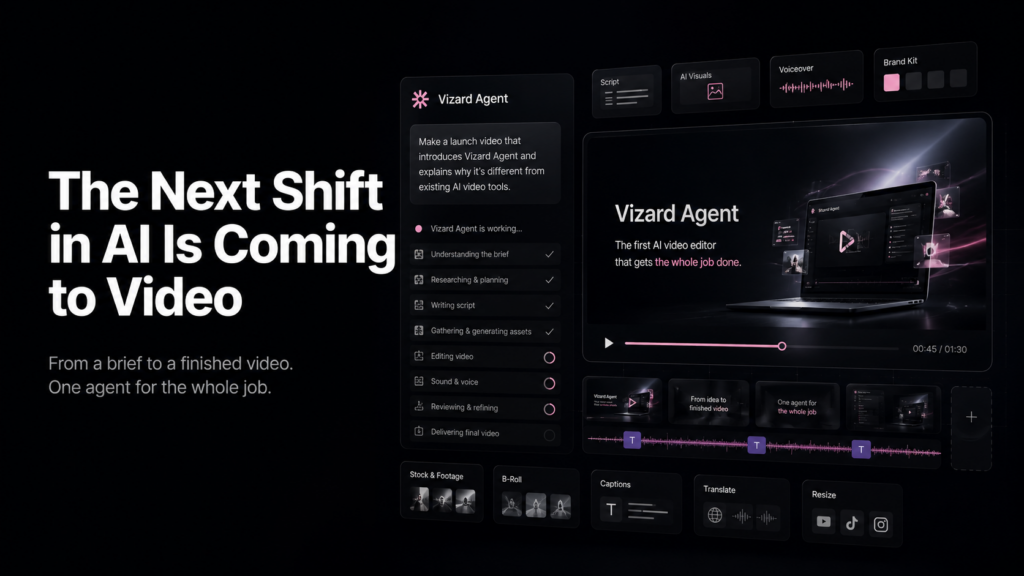
I wanted a piece of that, so I made a Niu Lai meme video in Vizard Agent. If you haven’t heard of it, Vizard Agent is an AI video tool: you feed it ideas and footage, it generates the visuals and assembles the final cut, so you barely have to edit anything yourself. This article is about why the film blew up, how I caught the trend, and how the video went from a half-formed idea to a finished cut. If you’re thinking of riding a trend with AI, maybe it’ll give you something to steal.
1. What Niu Lai Is
Niu Lai, which means “The Cow Is Coming,” is a Chinese animated feature that opened on August 5, 2026. It’s 86 minutes long, and its rise is genuinely backwards: total flop first, then an explosion.
The crew was two people, a mother and son from Dalian, a northern city of China: director Xin Yumeng and writer Sun Lifang. Over five years they built the whole film in SketchUp, a piece of architecture software (the director confirmed this in an interview). Reported costs vary wildly, but the figure that keeps getting passed around is about 1,000 yuan, roughly $150. In its first nine days, the film grossed around 7,000 yuan, roughly $1,040, and sold a couple of hundred tickets. On the worst day it took in about 100 yuan, roughly $15.
The turn came from the roasting that spread across Douyin (TikTok’s Chinese version) and Weibo. Models clipping through each other, stiff movement, voice acting that never quite lines up with the picture: all of it became the joke. From there the box office climbed to somewhere between 45 and 48 million yuan (roughly $6.7–7.1 million) (numbers differ by source), and related topics passed 2.7 billion views. Douyin alone accounted for 2.4 billion, according to NewRank.
The entire meme lives in one scene. The calf is in trouble and drags out a desperate “Mom—!” The mother cow, eyebrows slanted down, answers in a flat voice: “Niu Lai!” Call, response, two beats. It became the easiest remix template on the internet.
The international wave followed almost immediately. @tongbingxue’s clips took off on X, the full film went up on YouTube, photos of hand-drawn cinema posters spread out from Bluesky, and eventually USA Today and NBC ran stories. The film got filed alongside the “so bad it’s good” canon, Plan 9 from Outer Space, Troll 2, Morbius, and people started joking about wanting a 70mm IMAX release.
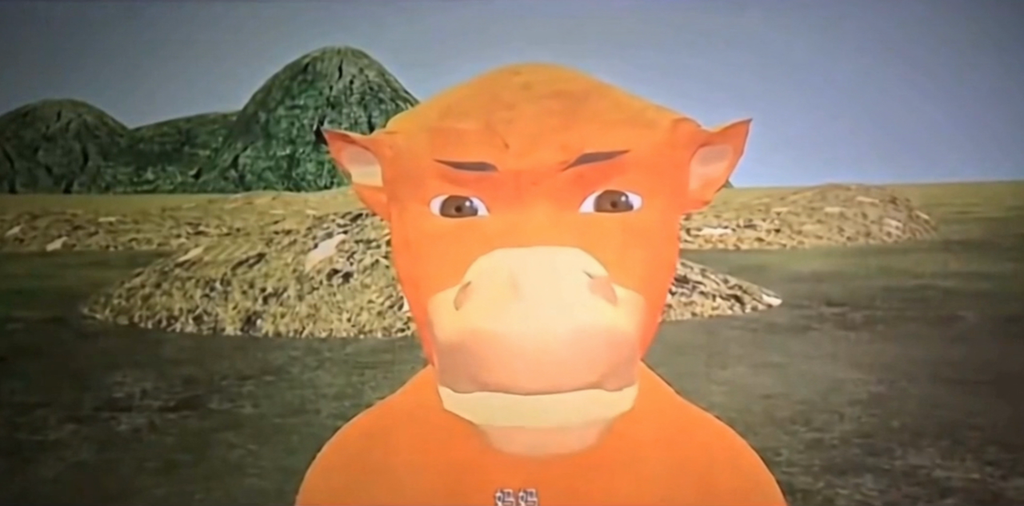
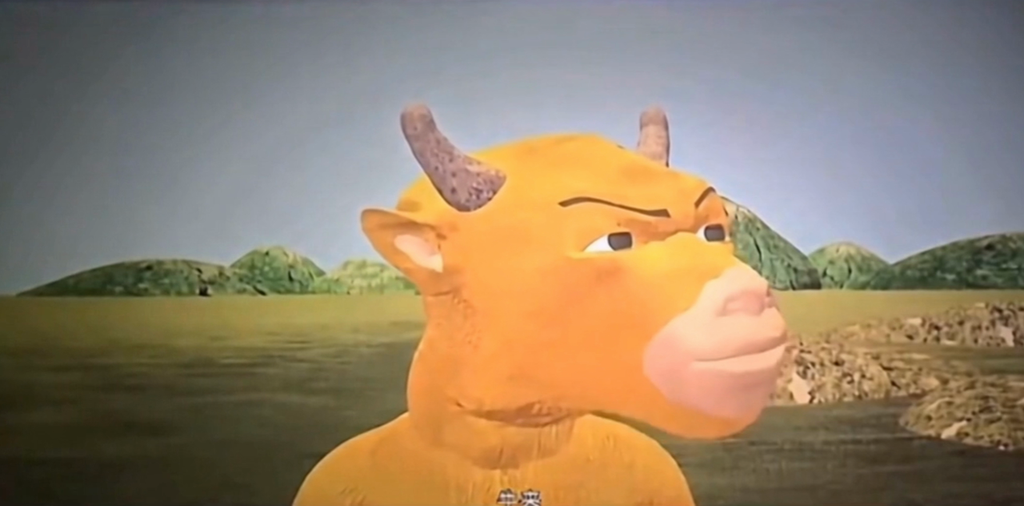
2. Why It Blew Up in China and Around the World
Ugly is the lowest bar for participation. With something polished, all you can do is clap. With something rough, you can copy it. “I could do that too,” and suddenly everyone wants in.
Anti-AI sentiment found its mascot. In 2026, when the feed is full of “AI slop,” a film that gets mocked as “worse than AI” became worth celebrating precisely because it was clearly made by humans, five years of clumsy effort baked in. International coverage latched onto this angle and gave it a name: “human slop.”
The famous scene needs no translation. One drawn-out “Mom” and a flat reply tell you everything in three seconds. No subtitles, no cultural background required.”X Lai” is a fill-in-the-blank template. Stock investors read it as “the bull is coming.” Brands followed with “snow coming,” “cat coming,” “goose coming,” “duck coming,” one after another. A meme you can fill in your lives longer.
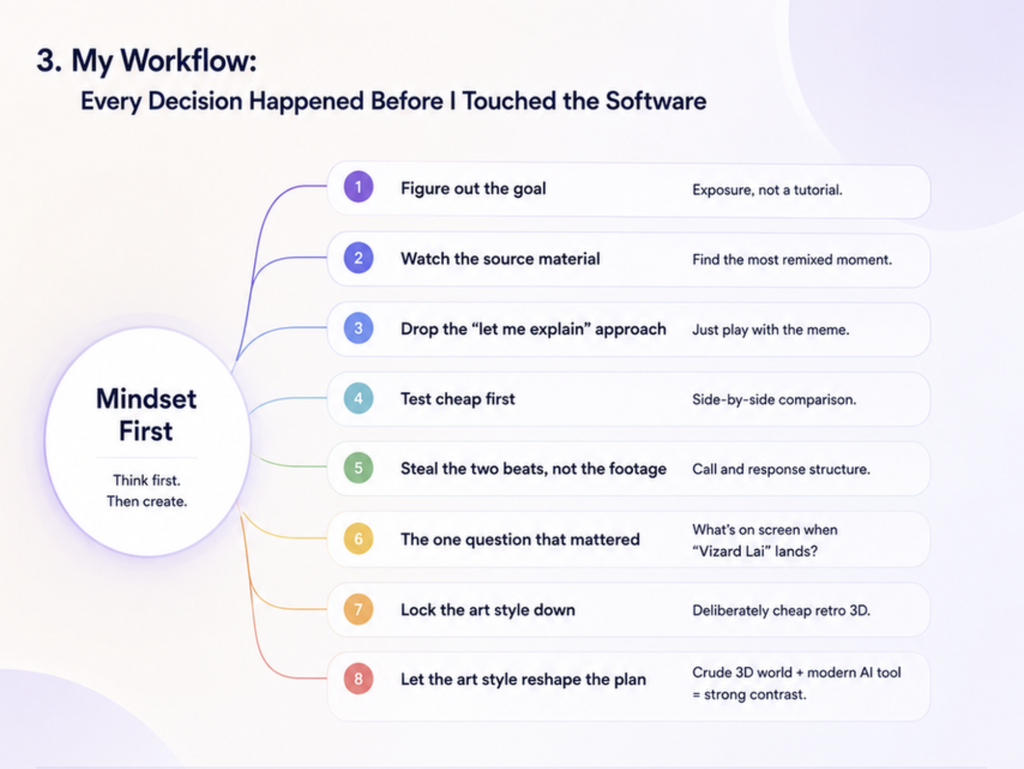
3. My Workflow: Every Decision Happened Before I Touched the Software
The real workflow isn’t in the editing software. It’s in the order you make decisions. I’ll skip the mechanics here and just explain how I thought, because these trade-offs apply to any trend.
Figure out the goal first: exposure, not a tutorial
I didn’t expect anyone to finish the video and know how to use Vizard Agent. I just wanted people to know it exists. So the path was fixed from the start: the trend brings eyes, the meme gets people sharing, Vizard Agent shows up for a split second. Not the usual formula of introducing the product, explaining features, teaching usage, then begging for a follow. On Instagram especially, nobody has the patience for a feature demo inside a 10-second clip. Once the goal is clear, everything else falls into place.
Watch the source material before thinking of ideas
I didn’t brainstorm first. I went through Niu Lai videos online and looked at which moment people remixed the most. The answer was unanimous: the calf’s “Mom—!” and the mother cow’s “Niu Lai!” Just those two beats. So I set out to copy those two beats, not the movie. What I learned along the way: the smallest replicable unit of a meme is the structure, not the character.
Drop the “let me explain” approach
I seriously considered the conventional route: why Niu Lai got popular, why low barriers mean anyone can try it, and therefore why you should give Vizard Agent a shot. I dropped it. Too much of a detour, and nobody works through a chain of reasoning while scrolling. The direction narrowed to: just play with Niu Lai’s visuals and the meme.
Test cheap first: a side-by-side comparison
My first version was the cheapest thing possible. Swap “Niu Lai” for “Pengu Lai,” split the screen, original on top, Vizard Agent’s version below. It came together fast and it was purely a test, to see whether the idea even worked. The test version itself isn’t interesting. The real video is the next one.
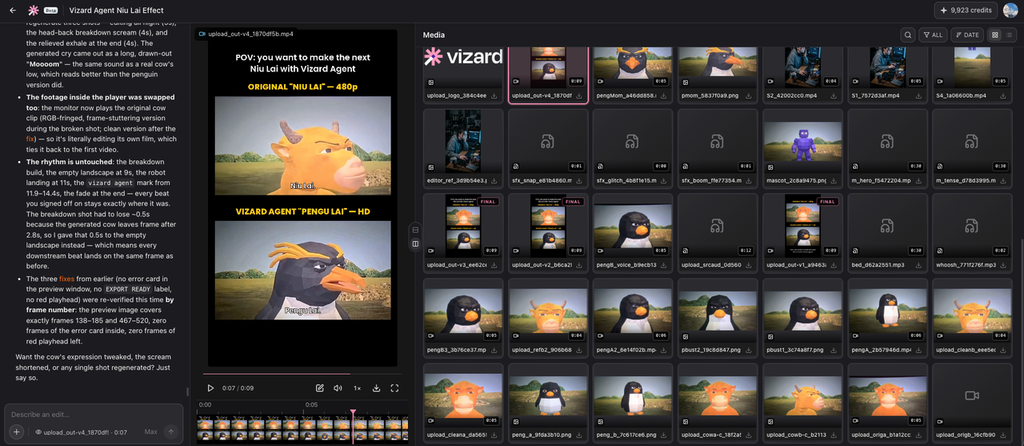
Brainstorming Result (V1 Idea)
The main video: steal the two beats, not the footage
The main video takes the call-and-response structure wholesale, without quoting any footage from the film. A calf stretches out “Mom—!” and a very calm voice answers “Vizard Lai.” I figured this one had more meme potential, but it was also the harder build.
The one question that mattered
At the moment “Vizard Lai” lands, what exactly is on screen? I had three options and ruled them out one by one.
A. Superhero-style arrival. Cinematic, but it reads as an ad.
B. AI magic: a pile of chaotic clips snaps into a finished cut. Flashy, but at the end of the day it’s another AI product ad.
C. An utterly ordinary character walks in, sits down, snap, cut to Vizard Agent, finished video. Closest to Niu Lai’s dead-serious absurdist comedy.
I went with C. That choice basically decided whether this would be a skit or an ad.
Lock the art style down, and make it deliberately cheap
I studied screenshots of the cow and snake scenes over and over, then locked the style: retro low-budget 3D, the kind of thing you’d see in early computer animation from the ’90s and early 2000s. Rough models, blurry textures, flat lighting, empty environments, weird proportions, faces that are slightly off.
The most important requirement was intentionally cheap-looking. I found that telling the AI just “retro 3D” gets you a polished kind of retro, which isn’t Niu Lai at all. That one line went into every shot’s generation prompt.
Let the art style reshape the plan
After locking the style, I changed plan C’s setup too. It was originally a human editor in a real office. I swapped everything into a crude 3D animal world. First half: a rough little orange cow at a computer, timeline in chaos, footage everywhere, misery at its peak. Then the cry: “Mom—!” Second half: in that same world, the savior walks in deadpan, says “Vizard Lai,” the screen clears, the mess gets organized, and there’s the finished video. A crude retro 3D world next to a slick modern AI tool. The contrast does all the talking.
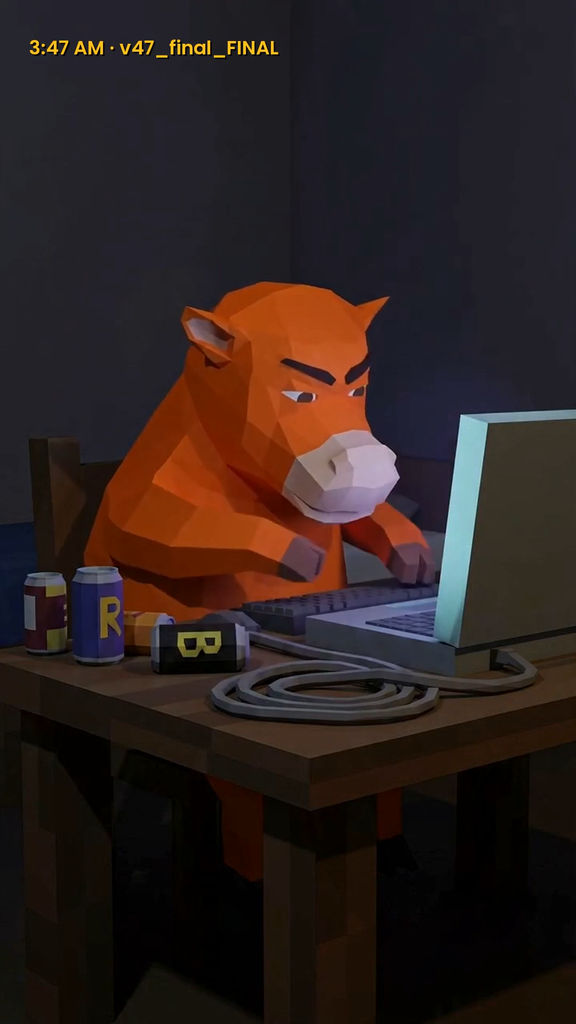
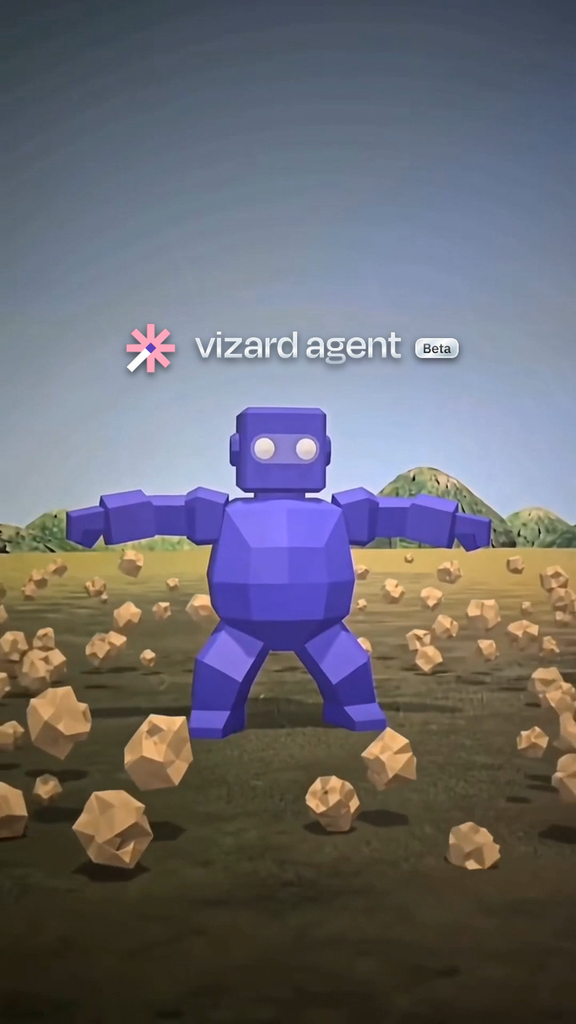
I set myself a rule: don’t make this an ad, make Vizard Agent a character in the meme. I wanted the reaction to be “haha, they’re riffing on Niu Lai,” not “another AI software ad.” So the product could show up as little as a logo, half a second of UI, or even just the words “Vizard Lai.”
Don’t start from “how do I shoehorn Vizard Agent into a trend.” Start from the most recognizable meme in the trend, then ask: what would this meme look like inside the Vizard world?
For a 6-to-10-second Instagram clip, one meme, one visual contrast, and a brief product cameo usually beat a full rundown of what the product does.
4. Once Production Started, I Did Three Things: Reference, Judgment, Acceptance
Once the thinking was done, the actual production was surprisingly light. I didn’t write a single generation prompt or touch the timeline. Vizard Agent did all of it. I had three jobs.
First, reference. I fed it clips of the original film, screenshots of the cow and snake (for the art style), the Vizard Agent logo file, and screenshots I’d taken myself at each review pass.
Second, judgment. Every time a version came back, I watched it and only said “this is wrong, here’s what I want.” Everything below is a content call, not a technical instruction.
| # | What I saw | What I wanted |
| 1 | The lead character was a penguin that didn’t match the original | Switch back to the orange calf from the film; unify the logo to vizard agent (with Beta) |
| 2 | “Vizard Lai” landed too early | Move it back to around 11 seconds so the breakdown has room to breathe |
| 3 | The “Vizard Lai!” whisper was nearly inaudible | Boost it until it’s clearly audible |
| 4 | A brand end-card was tacked on at the end | Cut it; end on the calf leaning back in relief, fade to black. Reads more like a skit |
| 5 | The UI had EXPORT READY / TIMELINE FIXED / a row of checkmarks | Remove them all; the purple sweep already says “fixed” |
| 6 | Frame-by-frame nitpicks: the preview leaked into another shot, a leftover error card, the playhead still red after the sweep | Circle them in screenshots. Not a single frame may remain |
Third, acceptance. The standard was one thing: no “close enough.” The last row of that table is a set of one- or two-frame problems, invisible at normal playback. I only found them by pausing frame by frame. Once found, my requirement wasn’t “make it better,” it was “not a single frame left.” The video went through six rounds of that.
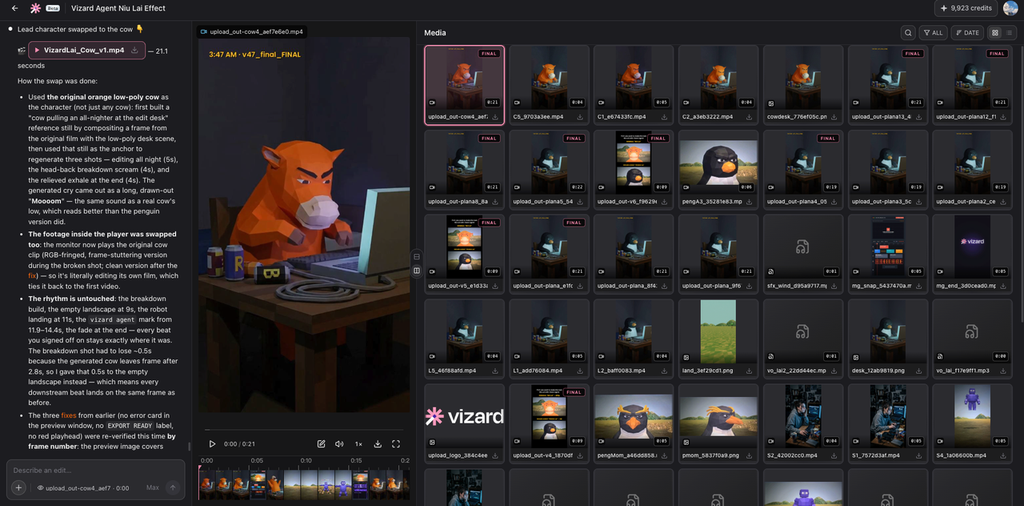
Everything I didn’t do went to the agent: writing generation prompts, timing, mixing audio, animating, frame-level checks. It delivered a version; I just checked whether it was right.
To wrap up: the creative judgment and the acceptance bar were mine. Getting it right down to the last frame was the agent’s job.
Note: if your remix directly quotes footage from the original film (this one used it in the on-screen monitor), check copyright and fair use before publishing.